
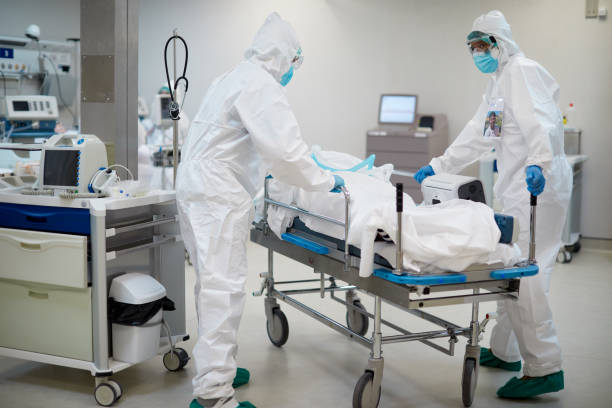
The official death toll from the early years of the COVID-19 pandemic was already staggering. A new study suggests it was also significantly incomplete — and that the people most likely to have been left out of the count were those who were already most vulnerable before the virus arrived.
Researchers using machine learning technology have estimated that approximately 155,000 COVID-19 deaths went unrecorded during 2020 and 2021, a period in which roughly 840,000 coronavirus deaths were officially documented on death certificates across the United States. If accurate, that figure means around 16% of all COVID-19 deaths in those two years were never formally attributed to the virus. The findings were published this week in the journal Science Advances.
The headline number itself largely confirms what other independent analyses of pandemic mortality have suggested. What distinguishes this study is its attempt to identify precisely who was being missed and why — and the answers it found reveal patterns that reflect deep and persistent inequalities in American healthcare and public health infrastructure.
Who Was Left Out and Where
The deaths most likely to have gone uncounted shared several characteristics. They were disproportionately Hispanic individuals and other people of color. They occurred predominantly in the early months of the pandemic, before widespread testing infrastructure existed. And they were geographically concentrated in specific states across the South and Southwest, with Alabama, Oklahoma, and South Carolina among those identified as having notably higher rates of unrecorded COVID-19 mortality.
The mechanism behind the undercounting was in many cases straightforward. Patients who died in hospitals during the pandemic were routinely tested for the coronavirus, creating a relatively reliable paper trail. People who fell ill and died at home or in other non-hospital settings were far less likely to be tested, particularly in the earliest months of the outbreak when at-home testing was not yet available and access to diagnostic facilities was uneven.
The structure of death investigation systems across the country compounded the problem. In many parts of the United States, especially outside major metropolitan areas, deaths are investigated not by trained medical examiners but by elected coroners who may lack specialized forensic or epidemiological training. Research has indicated that political attitudes toward the pandemic influenced both whether families sought coronavirus testing and whether coroners pursued postmortem testing in ambiguous cases. Some coroners reported direct pressure from families to omit COVID-19 as a listed cause of death.
A Count Tangled in Politics
The accuracy of COVID-19 death statistics became a contentious political issue almost from the beginning of the pandemic. Social media platforms were flooded with false claims suggesting the official numbers had been deliberately inflated. Those narratives found amplification at the highest levels of American political life, adding confusion and distrust to an already difficult public health communication environment.
The cumulative count maintained by federal health authorities now exceeds 1.2 million COVID-19 deaths since the pandemic began, with more than two-thirds of those occurring in 2020 and 2021. The new research does not challenge the idea that some pandemic-era deaths were misattributed to COVID-19. Rather, it argues that the opposite error — failing to attribute deaths to the virus when it was the actual cause — was both more common and more consequential than has been officially acknowledged.
The research team focused specifically on deaths among people confirmed to have been infected with the coronavirus. Using machine learning, they analyzed patterns in the death certificates of infected patients who died in hospital settings and then applied those patterns to a much larger set of out-of-hospital deaths attributed to conditions like pneumonia or diabetes — conditions that COVID-19 can cause or accelerate. The approach allowed them to identify cases where the underlying cause was likely coronavirus infection even when the death certificate did not say so.
Researchers outside the study acknowledged that the scientific community is still developing its understanding of the strengths and limitations of machine learning in this kind of epidemiological work, but described the methodology as a thoughtful and intriguing contribution to a field that remains critically important. The broader point the findings make — that marginalized communities paid a hidden cost during the pandemic that official records still do not fully capture — carries implications that extend well beyond the numbers themselves.